Gesamtzahl der Seitenaufrufe

Donnerstag, 7. März 2013

Government of Grenada:2005-15.9.25 Reg S Step Up (UNSUBORDINATED)

Grenada 25 SU Reg S (DUS) - 15.09.2025  Price: 48 USD Chg. (in%): ±0 USD (±0.00%) Volume: -
Bonds:Government of Grenada:2005-15.9.25 Reg S Step Up (UNSUBORDINATED)
Symbol: Type:Floating Rate NoteIndustry:Länder/Zentralregierungen
Valor:2282281Domicile:GrenadaExchange:Boerse Dusseldorf AG

Klage Im-Ex-Bank-China v Grenada
http://ftalphaville.ft.com/files/2013/03/13cv014501.pdf


Pari passu, the cross-sovereign contamination

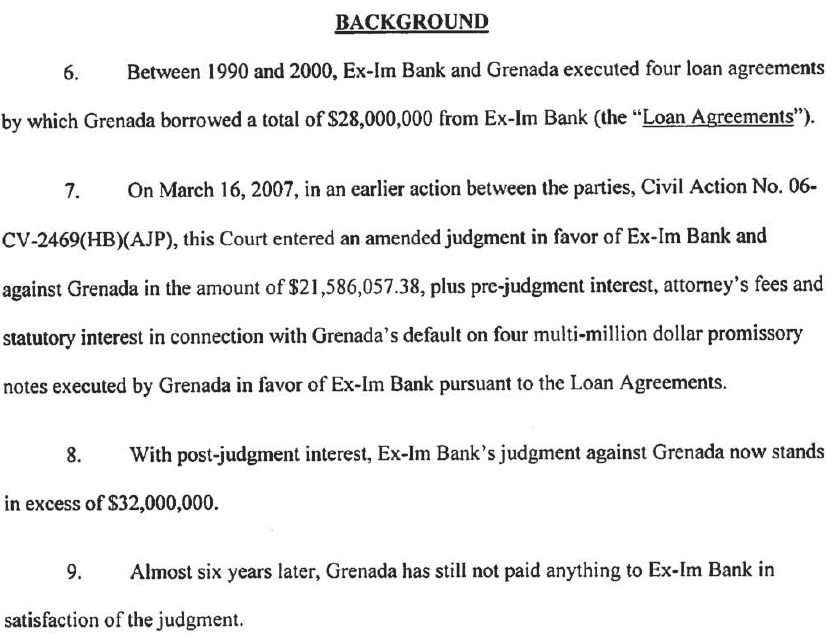
Some excerpts from a lawsuit filed by the Export-Import Bank of China (Taipei) against Grenada in a United States district court on March 4, 2013…
If you have been following the pari passu saga on ratable payment of sovereign debt — they tell their own story. (Click to enlarge all images.)
1.) Ex-Im Bank already has a judgement on $32m of debt defaulted on by Grenada.
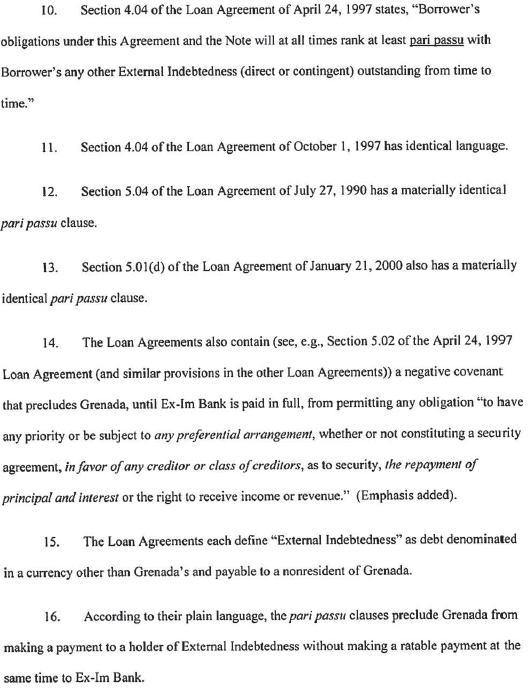
2.) The loan debt had a pari passu clause, and negative pledge language.
3.) Let’s just spell that last bit out, as cited by Ex-Im Bank.
According to their plain language, the pari passu clauses preclude Grenada from making a ratable payment to a holder of External Indebtedness without making a ratable payment at the same time to Ex-Im Bank.
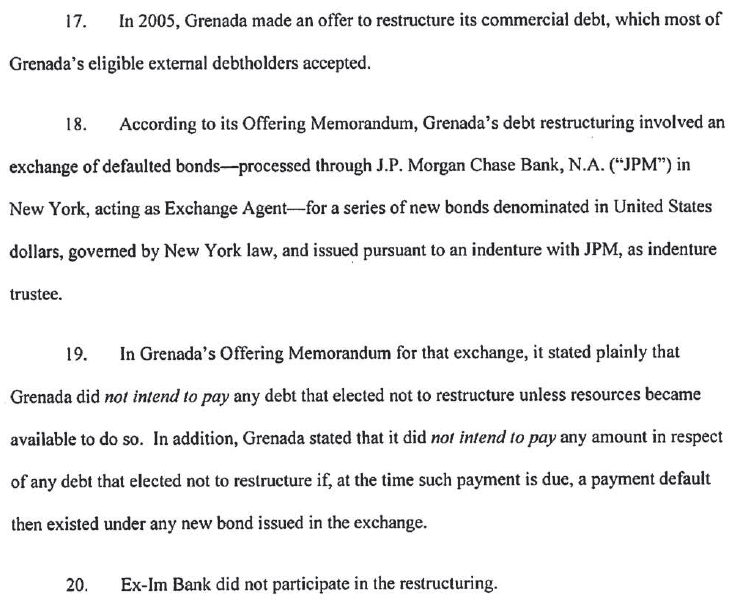
4.) Ex-Im Bank stayed out of Grenada’s 2005 debt restructuring.
5.) It has been watching Grenada pay the people who did restructure.
6.) Bank of New York handled some of that dough. Bank of New York lives in New York.
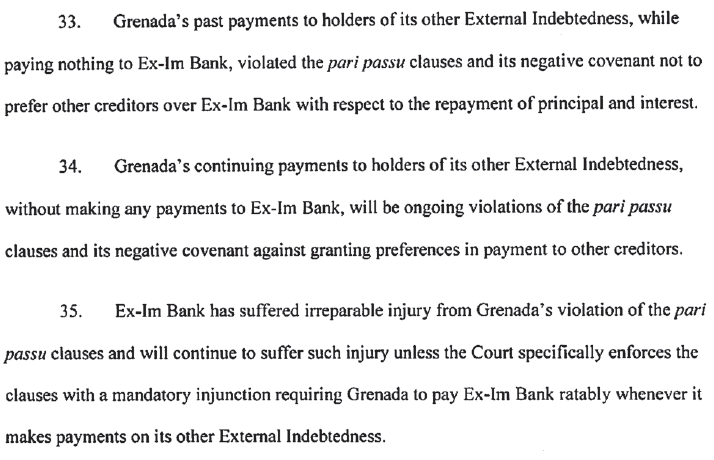
7.) Ex-Im Bank is now coming after these payments to Grenada’s restructured bondholders. (Hello, intercreditor consequences of ratable payment.)
8.) And Ex-Im Bank’s citing equity.
They didn’t even wait for a final Second Circuit ruling on Argentina making ratable payments to its holdouts. (Why should they, actually? The implications of ratable payment are arguably clear.)
Incidentally observe point 1) there, that Ex-Im Bank is exploring this avenue having already won judgement against Grenada. (The story of their dispute is a long one.)
The $1.3bn of claims involved in NML’s pari passu litigation against Argentina were not judgement debts. Nevertheless. EM Ltd, which holds a prior judgement against Argentina, said (in a pro-holdout amicus brief) that while “the District Court has not yet been asked to address whether the Equal Treatment Provision can be used to enforce an existing judgment,” EM Ltd “believes that the Equal Treatment Provision applies with identical force in the post-judgment context”.
And now we have crossed into new territory.
Post your own comment
User8095217Update your profile
Subscribe to comments
Comments
Sorted by oldest first | Sort by newest first
  1. Reportplasmaj | March 6 6:46pm | Permalink
    Except when they got their judgment they gave up their rights with respect to the bonds, including pari passu. Citi had a good piece explaining that.
  2. ReportJorge Marquez | March 6 7:31pm | Permalink
    Can you link that plasmaj? Or, at least, elaborate on what you just said. I'm intrigued...
  3. Reportanoldbanker | March 7 2:36pm | Permalink
    Argentina's equal treatment clause applies to payments; Grenada's only applies to ranking of the different debts. This is a critical distinction thoroughly discussed in academic analyses of pari passu.
  4. ReportJoseph Cotterill, FT | March 7 5:20pm | Permalink
    anoldbanker & plasmaj - Yep. Sure, it's not a particularly cast-iron case in itself (I think) because of the judgement issue and the lack of payments language. But it is striking and a sign of an important change that they thought they can even try.

Mittwoch, 6. März 2013

I can’t Belize it’s not ratable payment [updated]


I can’t Belize it’s not ratable payment [updated]

Update (Feb 26) – It turns out that we failed to be clear on something pretty important here… rendering our headline ironically pretty apt. Maybe you really can’tbelieve Belize’s disavowal of ratable payment on its bonds.
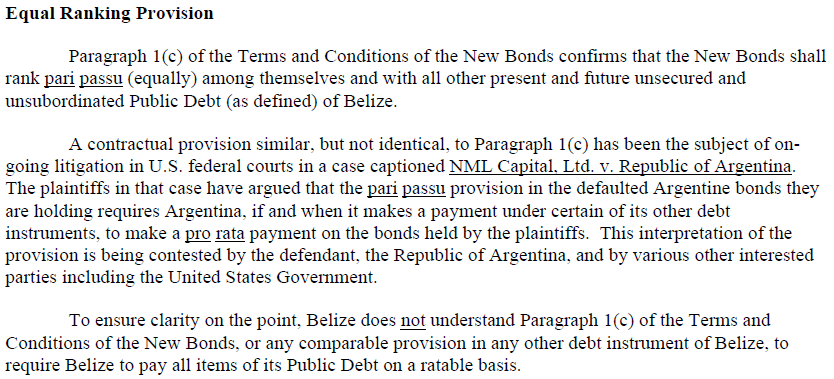
OK, so here’s the section on pari passu language in the new bonds’ Offering Memorandum:
“To ensure clarity on the point, Belize does not understand…” and so on.
Well, a couple of observers have pointed out to us that bondholders might not necessarily agree with Belize’s understanding. In other words, the disavowal might not protect Belize from legal challenge in the future, if it defaults on the new bonds. Why? Because Belize put the ratable payments disavowal in its offering memorandum — not in the actual contract for the new bonds. We should have made that clearer originally.
“Is that disavowal… important for the restructured creditors [to have]?,” we asked below. Well, no. They didn’t agree to put it into the contract, which is a sign that the bondholders didn’t agree with Belize’s interpretation in the first place, and did not wish to discard ratable payment.
That’s important to clear up, but it’s also interesting given what is really the most critical debate on obliging sovereigns to pay their bonds ratably.
The argument is about whether such an obligation can be inferred from a provision for equal treatment without the words ‘ratable payment’ having to be spelled out — or whether it needs sovereigns to issue debt with specific language attached. Beyond Belize, a case to consider might be Italy’s sale in 2010 of New York law debt with a promise to “pay amounts due… equally and ratably”.
At the same time, it’s worth noting that the Belize contract could arguably be called a ‘narrow’ pari passu clause because it talks about ‘ranking’ rather than ‘payment’ in terms of equal treatment. The offering memo itself has also come from a hotly-negotiated restructuring, emerging after extensive discussion on terms. But there’s a difference between a contract between two sides, and Belize’s interpretation of the contract given in an offering memo drawn up by its lawyers, or in a resolution of its own legislature.
We can also bring it back to events tomorrow in the Thurgood Marshall US courthouse, and whether Argentina has much chance convincing the Second Circuit. In October, the court agreed with a remedy of ratable payment for Argentina’s bond holdouts because it saw the dispute as a “simple question of contract interpretation.” Note the focus on contract.
Original post below the line.
_____________________________________________
It’s the week of the big hearing in the pari passu saga.
Argentina (plus the bondholders who agreed to be restructured between 2005 and 2010, plus Bank of New York) will try to convince the Second Circuit that it should change an order for the country to pay holdouts ratably as a remedy for breaching their bond contract. ‘Ratable’ is a term with a controversial history in sovereign debt but it basically means paying each creditor on the same basis, not paying one after the other.
Well, speaking of ratable payment… we’d just like to point something out from the Belize debt restructuring, which has been going on while the pari passu saga has trundled through courts:
Status of the New Bonds
The New Bonds will be general, direct, unconditional, unsubordinated and unsecured obligations of Belize and will rank at least equally among themselves and with all of Belize’s existing and future unsecured and unsubordinated indebtedness (it being understood that this equal ranking status shall not require Belize to pay all items of its bond indebtedness on a ratable basis).
A mere sub-clause, but what a sub-clause.
That wording comes from the Belize National Assembly’s resolution, passed this month, which authorises the government to issue new debt to bondholders. It includes the bonds’ basic terms and conditions (unfortunately the full Offering Memorandum itself is hard to track down — the offer period is still open), but it’s really that direct disavowal of ratable payment which is special.
Particularly in this restructuring.
Belize could have ended up as a pretty acrimonious default. It started out as one: the government played hardball last year, through missing a coupon payment on its $550m ‘Superbond’ — the result of its last debt restructuring, back in 2007 — and generally just not being nice to its creditors. The mood got better after the creditors formed a committee, allowing everyone to sit down to argue about economic projections and the chances of debt repayment.
Still, while Belize’s offer will be getting the acceptance it needs, the bond terms appear to contain some fairly innovative protections to make sure Belize can’t play hardball again. Joe Kogan of Scotiabank has observed that creditors get to claw back the 10 per cent reduction in bond principal which they’ve agreed to, if Belize fails to make a payment within the next decade. There also seems to be an account set aside for paying the expenses of a future creditor committee. As Kogan also notes, these protections could ultimately depend on being able to attach Belizean assets to force these payments — c’est la vie when litigating against a sovereign — but they’re nice to have.
So in this context Belize says that it doesn’t consider itself to have an obligation to pay ratably under these bonds. Is that disavowal important for Belize to have? Or important for the restructured creditors? Will it in some way shape the legacy of the pari passu saga?
Sovereign debt restructurings don’t come around very often, even these days. The new Belize bonds come five months after the Second Circuit first confirmed ratable payment for Argentina’s holdouts, making them (we think) the first debt exchange to react to the court’s decision. Some sovereigns have since sold New York law bondswarning that the Argentine litigation has now created legal risk within pari passu clauses, but unlike Belize they didn’t go into the weeds of ratable payment.
Maybe its disavowal means the Second Circuit really should revisit the Argentine order after all.
But then Argentina has previously argued to courts that no sovereign debtor in its right mind would ever agree to ratable payment, given the power it would give to holdouts. Is that right? The Belizean rewrite suggests that sovereigns do recognise the ratable implications of a promise to pay pari passu, and that they can easily adapt bond contracts to shut those implications down. Even in a sovereign restructuring. Or, rather, especially in a sovereign restructuring.
Sonntag, 17. Februar 2013

Government of the Province of Petchili

EILT - AKTUELL GESUCHT !!!

Liebe Sammlerfreunde,

die letzten 2 ½ Wochen war ich in den USA unterwegs, u.a. auch geschäftlich auf einer grossen Show für Stocks and Bonds in Washington D.C. Diese persönlichen Besuche eignen sich hervorragend um Kontakte zu amerikanischen Händlern und Sammlern zu vertiefen. So kann ich Ihnen aus erster Hand mitteilen, dass sich die Nachfrage nach spekulativen Anleihen aus Mexico, China oder auch Deutschland sich verändert hat. Stücke, die noch vor einem Jahr gesucht wurden, sind heute nicht mehr gefragt bzw. werden nur noch zu deutlich niedrigeren Preisen angekauft.

Im letzten Zyklus der Spekulation dürften sich auch die chinesischen Petchili Bonds befinden. Aus den USA habe ich noch einen Anfrage nach 10 Petchili Bonds mitgebracht, anschliessend wird ein grosser Abnehmer dieser Bonds seine Bücher schliessen.

Government of the Province of Petchili


Gesucht wird der 5,5% Gold Bond incl. Kupons über 20 Pfund vom 4. April 1913.

EILT – Diese Anfrage ist begrenzt auf maximal 10 Stücke.
Wir zahlen Ihnen für diese Ausgabe aktuell unglaubliche 2.000 Euro !!!
Bitte schnell anrufen (Tel. 0171-8971573) bzw. zusenden!
Abarbeitung strickt nach Anruf bzw. Eingang!


Alternativ haben Sie selbstverständlich die Möglichkeit diese Stücke auch in unsere Auktionen einzuliefern. Wir freuen uns über Ihre Einlieferung und würden die Papiere dann zum identischen Preis in der kommenden 103. FHW-Auktion in Berlin ausrufen.

Informativ: Letzte Auktionszuschläge 2012 lagen zwischen 1100 und 1600 Euro.

Folgende spekulativ gesuchte Wertpapiere können wir derzeitig direkt vermitteln bzw. nehmen wir aktuell als Einlieferungen entgegen:

- China – Liberty Bonds von 1937
- Banco de Londres y Mexico über 1000 Pesos
- Republica Mexicana 1843 – Tesoreria General, 5000 bis 27500 Pesos
- Republica Mexicana 1845 – Tesoreria General, 5000 bis 20000 Pesos
- Republica Mexicana 1885


Folgende spekulativ gesuchte Wertpapiere können wir derzeitig direkt vermitteln bzw. nehmen wir aktuell als Einlieferungen entgegen:

- Chinese Government, 5% Reorganisationsanleihe von 1913
- Königreich Westphalen von 1808 bis 1812
- Republica Mexicana ab 1842 bis 1914
- Estados Unidos Mexicanos von 1895 bis 1899
- Banco de Londres y Mexico von 1905
- Banco Central Mexicano von 1903 bis 1908
- Banco de San Luis Potosi von 1897
- Cuyutlan Gold Mines 1913


Bitte Stücke mit Angabe Ihrer Kontendaten zusenden an:

Aktien-Gesellschaft für Historische Wertpapiere
z. Hd. Herrn Michael Weingarten
Salzbergstr. 2
38302 Wolfenbüttel

Für Rückfragen stehe ich Ihnen gerne unter meiner
mobilen Telefonnummer 0171-8971573 zur Verfügung.


Mit allerbesten Grüßen


Hanseatisches Sammlerkontor
für Historische Wertpapiere


Salzbergstr. 2
38302 Wolfenbüttel
Deutschland
Tel.: +49 (0)5331 / 9755 - 33
Fax: +49 (0)5331 / 9755 - 55
E-Mail: info@historische-wertpapiere.de

Geschäftsführer: Michael Weingarten
Registergericht: HRB 872

Mittwoch, 3. Oktober 2012

BTA // We place BTASKZ’18 on a HOLD following today’s BTA announcement that an agreement was made on a non-binding term sheet on restructuring of US$11.2 bn of financial debt with a steering committee

Autor: koelner
Datum: Heute, 14:19
 
Meinung der UBS zum Plan bei BTA:

Second restructuring terms agreed

Terms better than expected

We place BTASKZ’18 on a HOLD following today’s BTA announcement that an agreement was made on a non-binding term sheet on restructuring of US$11.2 bn of financial debt with a steering committee excluding Nomura. Holders of Senior notes, Recovery notes and Original Issue Discount notes are to receive new notes and cash. New notes are to have US$750 mn notional, 5.5% coupon and maturity in 2022. There is currently no clarity as to the ranking of the New notes. Holders of US$2,247 mn senior notes would receive US$957.8 mn in cash plus US$88.6 mn of New notes or 42.6 c/US$ in cash plus 3.95 c/US$ in new notes a total payout of 46.6 c/US$. Holders of US$5,107 mn of recovery notes would receive US$660.2 mn in cash plus US$61.2 mn in new notes or 12.9 c/US$ in cash and 1.2 c/US$ in new notes a total payoff of 14.1 c/US$. The amounts to be repaid to subordinated noteholders are to be determined by the bank and would not change the entitlements of other creditors. Currently the total cash payment is US$1,618 mn or 14.4 c/US$ and total new notes are US$750 mn or 6.7 c/US$ implying a total payoff of 21.1 c/US$ on the US$ 11.2 bn financial debt being restructured. 

This might change once the restructuring terms of subordinated notes are announced. Samruk-Kazyna provided a generous support package of conversion of deposits into equity increasing its shareholding of the bank, increasing coupons to 6% from 4% on its bonds which are held by BTA and providing a US$1.592 bn loan at up to 4% p.a. coupon to BTA which is subordinated to new notes. We note that SK’s deposit as of 9M11 IFRS stood at US$2.1 bn We note that total cash payoff of US$1618 mn is US$26 mn above SK loan. This US$26 mn is to be paid to recovery note holders from the existing recovery units collection account. Post restructuring the bank would restore its T1 capital ratio above 10% under BASEL II with profitability to be restored after 2014. The restructuring is expected to be completed by end of FY12.


Ich bleibe vorerst mal drin. Die gebotenen 37 erscheinen mir noch zu wenig

Montag, 1. Oktober 2012

Belize Didn't Default On Superbond

Belize Didn't Default On Superbond
posted (September 20, 2012)
When we left you last night - the conclusion was that Belize had defaulted on its Superbond debt - but tonight, it seems not. A press release coming from the Coordinating Committee of Belize Bondholders - which represents the owners of more than 50% of the Superbond - issued a release today saying two important things: One, that they've given a 60 day extension on the payment due date for talks to progress, and two, that the Government has made a partial payment of the interest payment that was due on August 20th. That partial payment is 23.4 million Belize dollars, half of the 46 million that was due.And the release from the Committee also shows a marked change of tone. Whereas in the past they complained about lack of information and dialogue, today's release says quote, "conversations with the GOB are progressing towards a mutually agreeable restructuring of the Bonds and both sides have identified an appropriate framework to advance negotiations."
The Committee welcomes the partial payment and in exchanges co-chair AJ Mediratta offers, quote "the Committee has agreed not to seek legal remedies for a period of 60 days…The Committee is recommending that other bondholders refrain from seeking legal remedies during this period."
So, no legal action and where it once complained about a lack of information, the release now says, quote, "The Committee takes note of the debt servicing challenges facing Belize."
It's a Kumbaya moment for sure, but there are tough days ahead and a press release from the government of Belize says negotiations will advance on quote, a "workable approach to accounting for the effect on Belize's debt servicing capacity."
With the breathing room that this agreement gives, the next major development are expected in October when government starts to formally offer to exchange the existing bonds.

Home | Archives | Downloads/Podcasts | Advertise | Contact Us